This oral history interview is an intimate conversation between two people, both of whom have generously agreed to share this recording with Oral History Summer School, and with you. Please listen in the spirit with which this was shared.
This interview is hereby made available for research purposes only. For additional uses (radio and other media, music, internet), please inquire about permissions.
All rights are reserved by Oral History Summer School.
Researchers will understand that:


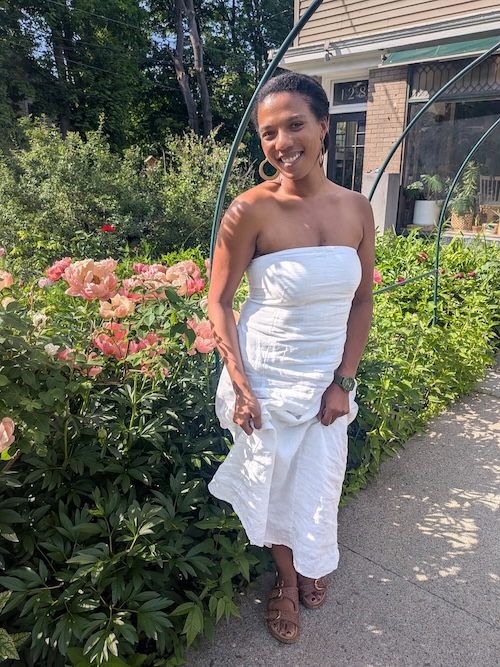
This interview is narrated by Vanessa Williams (she/her), Oral History Summer School Class of 2026. Vanessa begins by discussing her family, particularly her brother Terry and how he inspires her to be patient, curious, and funny, though she is not able to spend as much time with him now as she would like. Growing up in a working class, Black family in Jacksonville, FL, Vanessa describes her love of dance and how she taught herself ballet as a child, leading to a happy memory of receiving a ballet leotard on Christmas morning and then taking dance lessons for a semester. As a first-generation college student, Vanessa also discusses her journey to higher education with the help of a teacher, Mr. McKay, who encouraged her to apply to Davidson College in North Carolina. From there, Vanessa set herself on a professional path around the East Coast pursuing a Master’s degree and a love of teaching. The interview concludes with Vanessa’s reflections of living in Washington D.C. during the second Trump administration and her hopes for all to share their generosity and abundance to create the future. As of 2026, Vanessa is a museum educator based in Washington D.C.. She dabbles in dance and writing about dance, and she has varied her repertoire to include modern and contemporary dance in addition to ballet.
Elora Agsten (she/her) is a librarian, educator, and community-advocate-in-constant-training, based in Wooster, Ohio. She has worked in higher education as a teaching librarian for the past six years. Her teaching practice is centered in critical information literacy and asks students to consider not only the “what”, but the “why” to information creation. As a researcher, Elora examines the intersection of misinformation and communities and how the community can paradoxically be used to both prevent and spread misinformation. Elora is also active in community advocacy efforts throughout Wooster and believes firmly in the power of coalition and relationship-building. She is part of the 2026 Oral History Summer School cohort.
Oral history is an iterative process. In keeping with oral history values of anti-fixity, interviewees will have an opportunity to add, annotate and reflect upon their lives and interviews in perpetuity. Talking back to the archive is a form of “shared authority.”