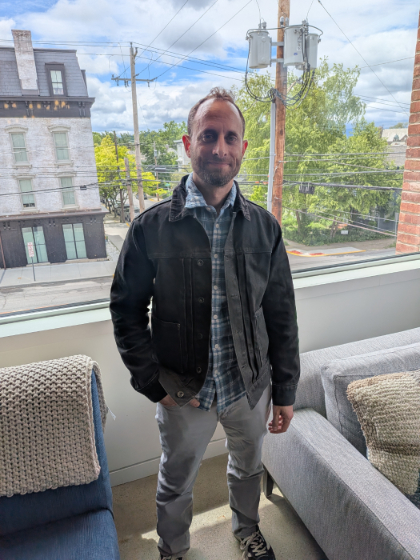
This oral history interview is an intimate conversation between two people, both of whom have generously agreed to share this recording with Oral History Summer School, and with you. Please listen in the spirit with which this was shared.
This interview is hereby made available for research purposes only. For additional uses (radio and other media, music, internet), please inquire about permissions.
All rights are reserved by Oral History Summer School.
Researchers will understand that:


Michael Chaimedes (he/him) is a political activist and former elected member of the Columbia County (NY) Board of Supervisors, based in Hudson. In this oral history, Michael discusses his entry into community activism, where he worked with his friends and their communities in Hudson to strike down a city ordinance surrounding playing soccer in a public park. Throughout the interview, Michael discusses how he has worked with the many communities of Hudson, particularly immigrant communities, to “level the playing field” and make Hudson a more welcoming and equitable place for all. Michael also reflects on his work to create anti-ICE ordinances within Hudson, to make sure undocumented immigrants could still obtain driver’s licenses, and to create a public “shopping shuttle” between Hudson and Greenport. This interview will be of particular interest to historians of local elections in the United States, as Michael discusses the history of recent election procedures and politics in Columbia County, as well as those who want to learn more about small town activism and progressive action.
Elora Agsten (she/her) is a librarian, educator, and community-advocate-in-constant-training, based in Wooster, Ohio. She has worked in higher education as a teaching librarian for the past six years. Her teaching practice is centered in critical information literacy and asks students to consider not only the “what”, but the “why” to information creation. As a researcher, Elora examines the intersection of misinformation and communities and how the community can paradoxically be used to both prevent and spread misinformation. Elora is also active in community advocacy efforts throughout Wooster and believes firmly in the power of coalition and relationship-building. She is part of the 2026 Oral History Summer School cohort.
Oral history is an iterative process. In keeping with oral history values of anti-fixity, interviewees will have an opportunity to add, annotate and reflect upon their lives and interviews in perpetuity. Talking back to the archive is a form of “shared authority.”