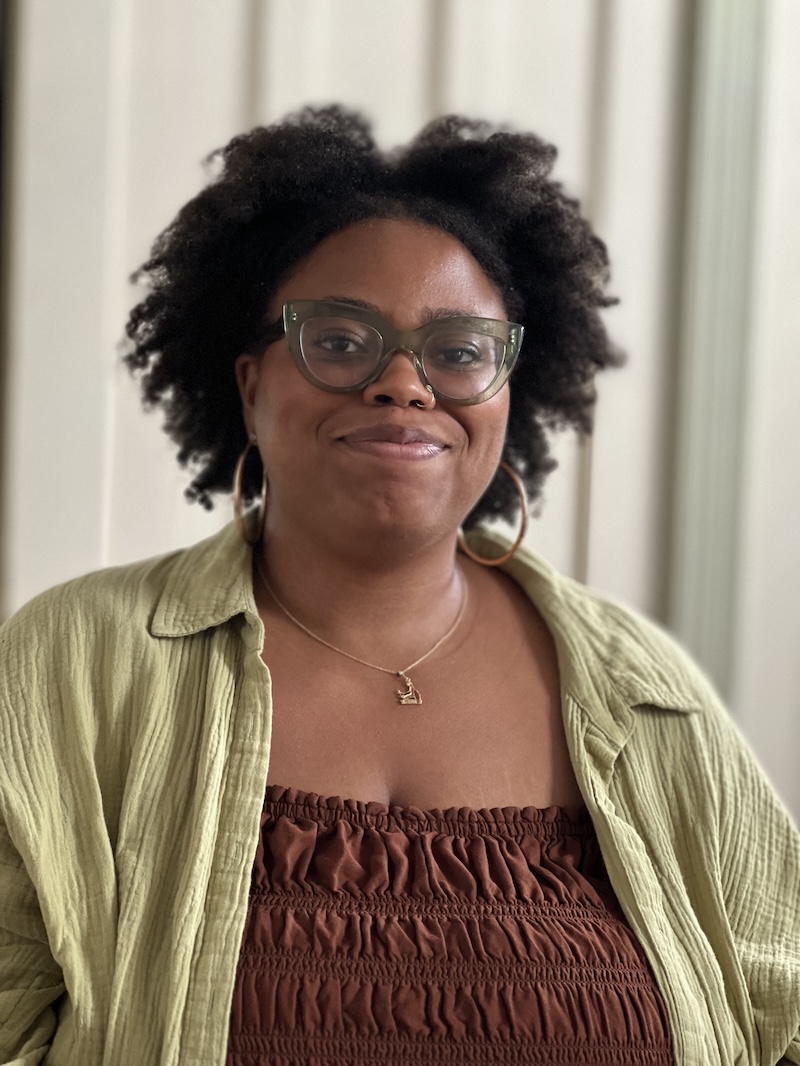
This oral history interview is an intimate conversation between two people, both of whom have generously agreed to share this recording with Oral History Summer School, and with you. Please listen in the spirit with which this was shared.
This interview is hereby made available for research purposes only. For additional uses (radio and other media, music, internet), please inquire about permissions.
All rights are reserved by Oral History Summer School.
Researchers will understand that:


This oral history interview with Gabriella Gladney, a freelance writer and audio producer based in Chicago, was conducted on June 26,2025 in Hudson, NY as part of Oral History Summer School. The conversation centers on Gladney’s personal experiences and reflections on Bronzeville, a historically Black neighborhood in Chicago, where she currently resides.
Gladney situates her story within the social, cultural, and architectural landscape of Bronzeville, touching on landmarks such as 43rd Street, the Green Line subway, and neighborhood architecture. She reflects on the area’s deep ties to Black history, business, and community, drawing connections to her own family history, with grandparents in Chicago andRockford, IL.
The interview captures memories of theaters, block parties, and jazz festivals, while also addressing ongoing challenges such as gentrification, redlining, segregation, crime, food deserts, and public housing legacies like Cabrini Green. Gladney contrasts these with emerging opportunities, including community-driven spaces like Borxville (shipping containers transformed into a business hub), Overton Elementary’s repurposed community use, wellness sanctuaries, farmers markets, and clothing swaps.
A recurring theme is the tension between preserving neighborhood character—highlighted by beloved local establishments like Cleo’s Southern Kitchen, Pearl’s Soul Food, Bronzeville Winery, and Blanc Gallery—and the pressures of redevelopment and displacement, particularly with projects like the Obama Presidential Library and tech investments in the South Side.
Ultimately, the project documents Bronzeville as both a resilient historical community and a site of ongoing struggle and innovation, where residents actively negotiate the balance between honoring the past and shaping a sustainable, inclusive future.
Armando Estrada is a Mexican American sound artist based in San Antonio, Texas. He currently serves as the Radio Manager at Empower House Radio, where he is dedicated to amplifying the voices, stories, and sounds of his community through high-quality audio production. Deeply rooted in cultural preservation, Armando sees his work as a continuation of his ancestors’ legacy—documenting lived experiences to inspire and inform future generations.
Through the mediums of sound and music, Armando has exhibited and performed his work across the United States and Mexico, including in San Antonio, Austin, Chicago, Colorado, California, New York, Wisconsin, and various locations throughout Mexico.
Oral history is an iterative process. In keeping with oral history values of anti-fixity, interviewees will have an opportunity to add, annotate and reflect upon their lives and interviews in perpetuity. Talking back to the archive is a form of “shared authority.”